
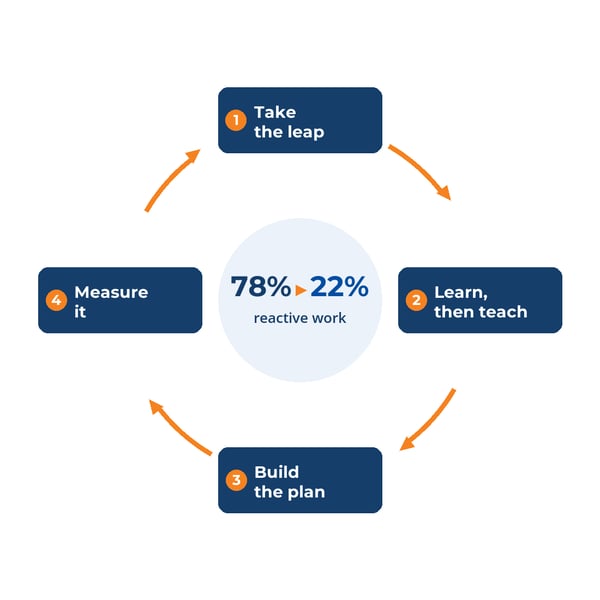
They offered him a wood products plant running 78% reactive.
He knew exactly what he was walking into. He took the job anyway, because he believed he could make a difference.
If you run maintenance, you know that plant. Most of the week goes to whatever broke last night. The schedule is a suggestion. And somewhere in a drawer there's probably an analysis that already says what needs to change.
The analysis knows. Leading the change is a different job.
I'm not guessing about what that costs. Earlier in my career I was a continuous improvement manager, responsible for the maintenance function at a large manufacturing facility. Two maintenance managers reported to me, and close to a hundred people. Several production lines were struggling to make their numbers, and the pressure was intense. The late-night calls all said the same thing. Failed equipment. Again.
Somewhere in there I knew there had to be a better way, and I went looking for it. What we found was education and coaching. Our team defined the path forward and implemented maintenance and reliability best practices. Real capacity improvements. Less waste. Lower maintenance costs.
So when I tell you what this manager did, understand that I know the weight of it.
What the turnaround looked like
He and his team cut maintenance costs by 50%.
They took the plant from 78% reactive to 22%.
Schedule attainment went from near zero to 78%.
Read that middle line again. That's a different plant.
Behind numbers like those are choices, and they're choices anyone facing their own version of that plant can copy. I count four, and every one of them is a leadership choice.
Take the leap
When management approached him about the role, he knew the state of the plant. You already know why he said yes.
That's the first choice: a willingness to take risks and embrace adversity rather than walk away from it. You must be willing to take the leap and take the first step. And acknowledge the fear that comes with the uncertainty. Fear is a natural human response, especially when you're new to a role. When you expect it and name it, you can keep it from becoming paralyzing.
Learn from others, then teach others
You can learn something from everyone. Be a sponge. Seek out knowledge and concepts that aren't yours yet. Learn something new, or take a subject you already know and go deeper.
Then do the half most people skip. Share it. Look for chances to pass on what you've learned to your peers. Write for industry publications. Get to conferences and workshops and stand up in front of people.
Here's what that looked like in his case. Before he moved up to a corporate reliability manager role, he developed ten Certified Maintenance and Reliability Professionals and eighteen Certified Maintenance and Reliability Technicians. And in the new role, he kept developing people.
He fixed a plant, and he built a bench. That's the kind of choice that can turn one person's turnaround into a culture. Continuous learning. Knowledge sharing. Succession planning that actually exists.
Build the plan
Create an action plan for the implementation.
Maybe it's a digital transformation. Maybe it's best practices. Either way, the only way forward is to take the first steps. And a written strategy does double duty: it's your roadmap, and it's the communication tool you share with everyone whose help you need.
Measure it
Develop measures that reflect your success and your team's. You don't want to do the work and be unable to show the improvement.
He could say 78% became 22% because they were measuring. Make sure you can say your version of that sentence.
The moment that decides
There's a name for the day he said yes: a defining moment. John Maxwell said it plainly. "A defining moment is a challenge or crisis that demonstrates the leadership capacity that lies inside a person."
Sometimes one arrives as a crisis. A safety incident. A catastrophic equipment failure that costs you downtime and money and forces you to confront the weaknesses in how you've been working. And sometimes it arrives quietly, as a job offer you'd be forgiven for declining.
Nobody chooses the moment. It chooses you, and what you do next is the defining part.
What will be your defining moments?
If you want the structure underneath it
That manager didn't stop at fixing a plant. He built people, and he kept building them from his next role.
Getting there takes more than one good decision. It takes a structure. What has to be in place, and in what order, so the gains don't depend on one person's heroics.
That structure is what my free guide covers: 9 Steps to Building a Sustainable Maintenance & Reliability Organization. It walks the build in order, step by step, so you can see where your plant stands and what comes next.
Request the 9 Steps guide here.
Your plant has its own 78% number. This is how you start moving it.
Where we can help
The manager in this story didn't turn that plant around on willpower. He ran on what he'd learned, then multiplied it by teaching others. Our Maintenance and Reliability for Managers course is based on the CMRP Body of Knowledge, the same body of knowledge behind the certification he helped ten of his own people earn. And because seventy percent of implementations fail on the follow-through, not the training, our coaching and mentoring stays beside you while you implement and sustain the change.
Reactive maintenance FAQ
What is reactive maintenance?
Reactive maintenance is work that happens after equipment fails, instead of work that was planned and scheduled ahead of the failure. In a plant running 78% reactive, most of the crew's week goes to whatever broke last night, and the schedule becomes a suggestion.
What is schedule attainment?
Schedule attainment is the share of scheduled maintenance work that actually gets completed in the week it was scheduled. It tells you whether the schedule is running the plant or the breakdowns are. In this turnaround it went from near zero to 78%.
How do you reduce reactive maintenance?
Treat it as a leadership job. The four choices in this story are the path: take the leap, keep learning and teach what you learn, put the action plan in writing, and measure the results so you can prove the improvement. That approach took this plant from 78% reactive to 22%, cut maintenance costs by 50%, and moved schedule attainment from near zero to 78%.