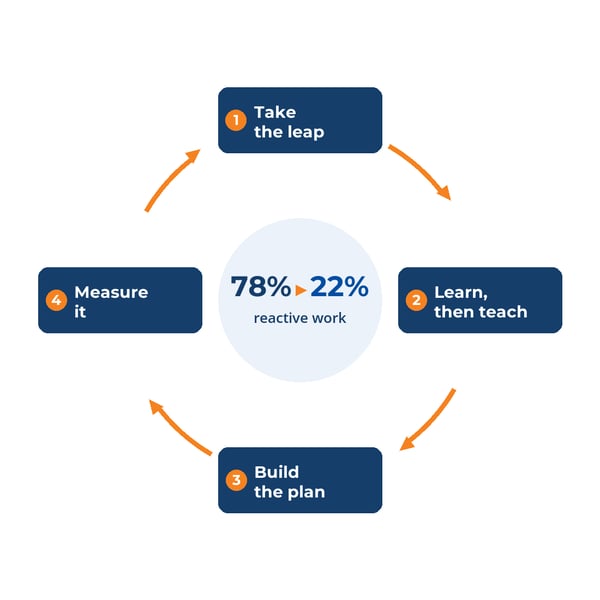
Ask a plant manager how hard the maintenance crew works, and you will usually get a straight answer: hard. Long hours, weekend call-ins, always something on fire. So the number tends to land like a slap.
A maintenance planner's job is a crucial part of any successful maintenance and reliability program. Maintenance planners have a lead role in ensuring that all equipment and machinery is properly maintained, repaired, and, if necessary, replaced in a timely manner.
by Cliff Williams, on January

Many times, we are asked to visit organizations with a view to identifying where the biggest challenges to a successful maintenance and reliability lie. Quite often we are shown where the problems lie but there is no real understanding of ‘why’ they exist. There is one situation that arises in pretty much every organization in some form or other and that’s a disconnect between maintenance and the procurement or storeroom functions. There are many variations on who does what in this function and even who owns what, far too many for me to go into every scenario, so for the sake of this blog I’m going to treat them as three separate functions and you can fit them to your situation.
by Admin, on July

In business, we use acronyms to communicate and abbreviate content. One such acronym KPI (Key Performance Indicator) we hear and use regularly. In maintenance there are several KPI’s used including those tracking MRO Storeroom performance. Recently we conducted a poll asking which Storeroom KPI people considered most important.

Seemingly overnight, the challenges for the maintenance function intensified. Some organizations faced reduced sales and product demand, pushing the organizations to reduce budgetary spend. Meanwhile, others have pivoted with new products or increased production demand requirements. In either case, the need to improve performance and maintain reduced costs remains a strong focus.
From my experience, there are no better tools than education and the use of a guide to coach people to implement a proactive maintenance organization focused on improving performance and reducing cost. The use of one should lead to the use of the second in tandem.
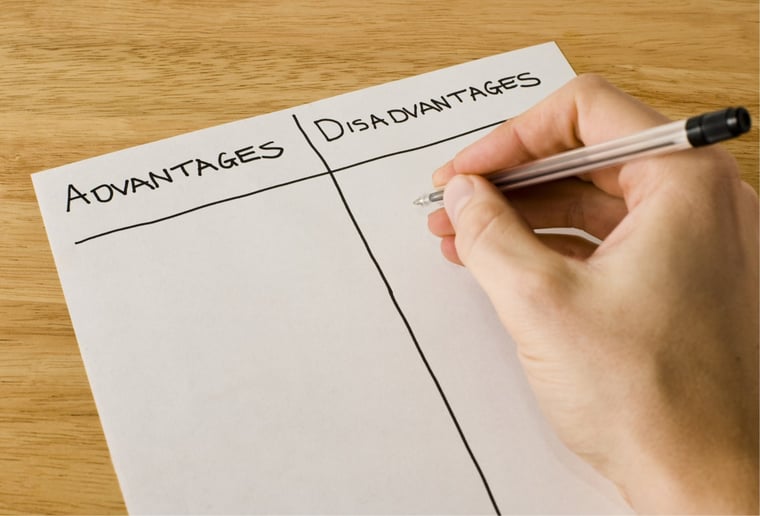
At People and Processes, Inc., we are pleased to provide effective solutions for both. In the table below, you can see the advantages and disadvantages of different training approaches. Currently, we offer both the instructor-led classroom and virtual interactive training courses. We are also developing the on-demand eLearning training courses as well.
So, what is the best learning method for you?
| Activity | Instructor-Led Classroom Training | Virtual Interactive Instructor-Led Training | On-Demand eLearning |
|
Instructor access to answer questions and facilitate the discussions for learning |
Advantage of real-time immediate access and visual feedback |
Advantage of real-time immediate access and feedback but cannot see faces of peers in large groups due to bandwidth limits. Using our technology platform, attendees can interact in main areas and in breakout rooms. The instructor can interact in all areas. |
Disadvantage due to time-differences and schedules due to on-demand nature. It may be hours before receiving answers or feedback. |
|
Peer-to-peer networking and learning |
Advantage due to sharing of physical space, visual cues, and group interactions. |
Advantage due to break-out rooms and interactive tools enable one-on-one and group interactions. |
Disadvantage as above and attendees are left to initiate the desired levels of interaction outside of course requirements. |
|
Travel expense |
Potential disadvantage if travel costs are incurred to an on-site location for attendees. Instructor travel is a potential cost. |
Advantage as the training can be attended from any location using a laptop and high-speed internet. |
|
Engagement of learner and transfer of knowledge |
Advantage due to adult learning concepts, interactive exercises, and gamification |
Advantage due to adult learning concepts, interactive exercises, and gamification. | Potential disadvantage as not everyone learns well in this approach. Engagement can suffer with competing priorities and learner may focus on gaining minimal knowledge to complete the module assessments to advance through course. |
|
Time commitment |
Fixed amount including potential travel |
Fixed - typically, less time is required over classroom training, especially without the travel considerations to an on-site location. | Self-paced flexibility based on individual motivation. |
Check out our upcoming Virtual Interactive Instructor-Led Courses Here
by Jerry Simpson, on May

How can you turn your maintenance planners into the foundational building blocks of a world class Maintenance organization?
During various maintenance process improvement initiatives that I have been a part of over the years, the role and function performed by maintenance planners and schedulers invariably surface as an integral piece to achieving best practices.
There are maintenance groups out there right now that have not yet reached into the world Of things like reliability-centered maintenance or invested in condition-based technologies, etc…but do normally have some vestige of a Planning process (for better or worse) to insure their technicians are being given the support they need to be effective.
If we were to consider that a planner may be required to plan for the activities of 15-25 while also controlling costs and supporting overall reliability initiatives, then the competencies of those individuals need to be considered.
Planners are ideally selected from the craft roles, and shown how to use the CMMS to create work orders. Those same individuals may even have been given some training in planning principles and then put to work.
Later, it is often assessed that planning is not working well. We wonder why that could be. It has been my experience that planners need to not only be selected with care and trained initially, but also coached until a desired level of competency is achieved.
An experienced practitioner can first assess your planners against best practices. On reconciling the findings, coach them in one-on-one sessions against a standardized and scored framework in subjects like:
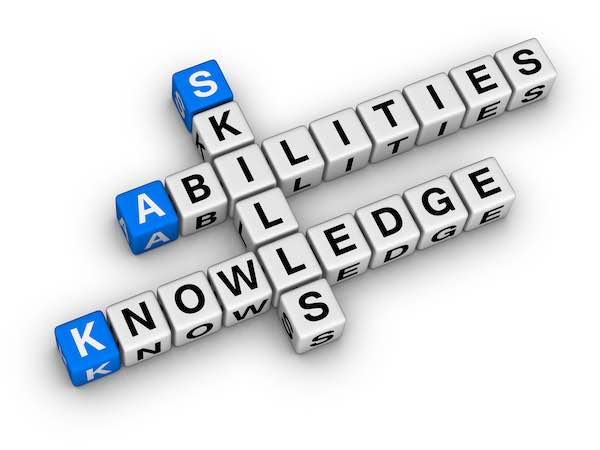
The goal is to develop a specified level of competency that demonstrate the planner's ability, knowledge, and skills in measurable approach.
Coaching is an investment in this integral role and can be conducted in short sessions either in person, or virtually, until competency is achieved.
by Jeff Shiver, CMRP, on April

People and Processes, Inc. is announcing interactive live virtual interactive instructor-led classes for people working in maintenance and reliability across industry.
Many of our reliability training and service offerings have traditionally depended on travel to public venues or sharing physical space on the client sites. With the newer digital landscape, we have been tirelessly working to create solutions that enable our clients to attend our courses from anywhere they have a digital connection. As our overseas clients have been asking for the same access for some time, we had planned to introduce these offerings later this year. We are excited to announce that we have accelerated our efforts and pulled the course launches forward.
Two of the most popular classes, our Maintenance Planning and Scheduling course, is scheduled for April 28-30,2020 and our Maintenance Storerooms and Materials Management course is scheduled for May 7-9,2020. For these course dates, we are offering a 45% reduction in the standard course fees to assist companies with their immediate training requirements. Additional courses will be added to the People and Processes, Inc. Institute website as the dates become available.
Our interactive live virtual instructor-led training combines the same course concepts developed by our industry-leading and certified practitioners found in our classroom training. Leveraging our virtual instructor-led training enables the real-time benefits typical of classroom learning with our certified instructors combined into an interactive and engaging learning experience via your remote environment.
About People and Processes, Inc.
People and Processes, Inc. experienced practitioners provide consulting and training to improve industrial equipment maintenance and exceed your targets. The company works in all verticals to include facilities, manufacturing, mining, municipal government, universities, and water as examples. Our offerings include CMMS/EAM implementation, assessment and benchmarking, work execution management, storerooms, and RCM3. Our industry partnerships include The Aladon Network, The Reliability and Maintainability Center at the University of Tennessee (RMC-UTK) and we are a Tier 5 Approved Provider for the Society of Maintenance and Reliability Professionals (SMRP).
Contact Us
People and Processes, Inc.
Tammi Pickett, Marketing / Business Development
tpickett@peopleandprocesses.com
(843) 814-3795
by Jeff Shiver, CMRP, on March

If you are like many Maintenance Planners that I have the opportunity to interface with, most aren’t doing much using the job plan concept. The intent of the job plan is to better enable the craftspeople to execute their job with the materials, tools, and information in hand. Ideally, you really want a template to facilitate the development of these job plans.
What should some of the headers be for a job plan template? Here’s an outline that you may want to start with.
Most of these outline items can be used regardless of whether it’s a PM or Corrective Action job plan. Is there anything else you would add?
by Cliff Williams, on June
Still the most challenging topic most companies face in maintenance and reliability is one of leadership. Many organizations feel that they are not achieving the effectiveness and efficiency they believe they should due to a lack of understanding of leadership. The one thing that has stood out in my recent visits to organizations to help with this challenge has been the lack of a fundamental of leadership – managing. The interesting part is that each organization recognized they needed work on things like motivation, inspiration, involvement, engagement etc. but none recognized that their structure and systems for managing were broken. If we don’t have the systems in place to manage and control how do we expect to demonstrate those afore-mentioned traits of leaders? We need to remember that a good manager may be a good leader, but good leaders MUST be good managers. Too often we think of leadership in the philosophical terms that were mentioned but as the leadership guru Peter Drucker’s “Effective leadership is not about making speeches and being liked; leadership is defined by results not attributes.”
Having Leadership and Supervision issues at your site? Want to make a change ? Let us bring our Maintenance Leadership and Supervision Course to you.
by Cliff Williams, on August
How many times have you walked around a hardware store or a kitchen store and seen a tool or instrument that just made you shake your head and say to yourself ‘Wow if I’d had that when I tried to do…………………………….. life would have been so much easier!’